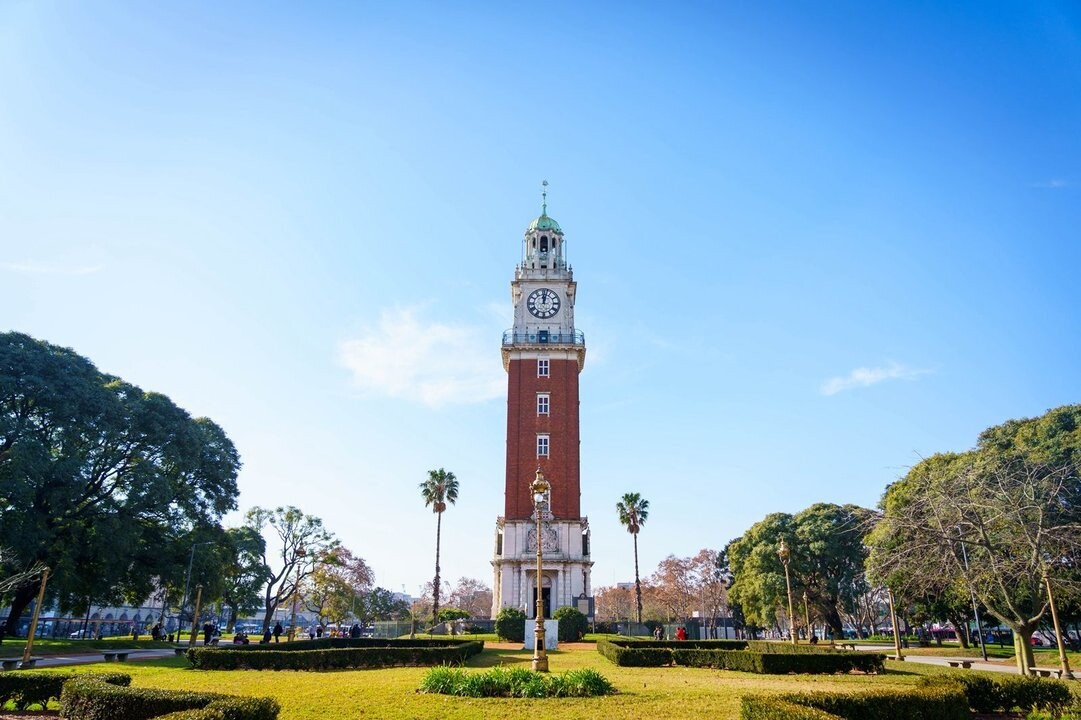
Since its inauguration on May 24, 1916, in the Retiro neighborhood, the Torre Monumental has quickly become a symbol and a landmark for everyone arriving in the city of Buenos Aires. Most people know it as the Torre de los Ingleses due to its origin. Located on Plaza Fuerza Aérea Argentina (formerly Plaza Británica), specifically at the intersection of San Martín and del Libertador avenues, in front of the Retiro train station, it was conceived as a gift from the British community residing in Argentina for the centenary of the May Revolution in 1910. Construction began in 1912, after the English gas factory located on the site moved out. At the time, it was one of the tallest buildings in the city (60 meters high), made up of 55,000 bricks brought from Great Britain. Along with this structure, the imposing Gillet & Johnston clock also arrived from England, imitating its twin in the Big Ben tower. The main bell is located on the eighth floor and is activated after the chime only on the hour, with one hammer strike for each hour. On the eighth floor are also the four chime bells that sound every 15 minutes. Three weights hang from the sixth floor: one is for the chime, another is for the clock itself, which keeps the pendulum in constant motion, and the last one is for sounding the main bell every hour: one strike at 1 o'clock, 12 strikes at 12 o'clock. As time passes, the weights descend. When one of the weights reaches the lowest point, on the fourth floor, the motor that controls it activates and raises it again so that the mechanism continues to function. The clock's mechanism is in charge of Javier Terenti, who has been in charge of this monument for almost 20 years. "Every week I come to the clock and perform preventive maintenance, which consists of lubrication, cleaning of the parts, I carefully inspect every corner of the machinery and adjust all the pieces, among other tasks," he says. Terenti already knows every piece and knows how to proceed in each case just by listening to the clock, like a cardiologist auscultating his patient. Throughout the 20th century, the monument became a faithful witness to urban development and the different waves of immigration that turned Retiro into one of the main gateways to the city of Buenos Aires, through the port and the train station. Even today it is considered a National Historic Monument. The clock continues to be a time reference for many passengers hurrying from the Retiro station who, even having the time on their cell phones, trust much more in the temporal certainty provided by the centenary mechanism. In 2012, the official name was changed from "Torre del Reloj" to "Torre de Isabel", in honor of Queen Elizabeth II's Diamond Jubilee. Another great distinctive feature is the Gothic style of the London tower, while the one here adopted a Renaissance style. All these stories and more details about its construction can be appreciated in the guided tours offered from its viewpoint. During the full moon and waxing crescent nights, from 8:00 p.m. to 9:30 p.m., the public can access the viewpoint of the Torre Monumental and enjoy a talk that will tour the history of the centenary National Historic Monument. During the visit, the ascent to the viewpoint allows one to observe the moonrise and enjoy panoramic views of the Retiro neighborhood and the nocturnal urban landscape. The activity is free, with prior registration and limited spots, and is suspended for rain. Special guided tours to the historic clock will also be held, which will allow visitors to learn about its operation and access a sector of the building not usually open to the public. This proposal is only for adults, requires comfortable footwear and is not suitable for people with reduced mobility as it includes a steep climb up stairs to the clock. The first Tuesday of each month is closed. Opening hours: Monday, Tuesday, Thursday and Friday from 10 a.m. to 5 p.m.; Wednesday from 1 p.m. to 5 p.m.; Saturdays, Sundays and holidays from 10 a.m. to 6 p.m.